
Portable Planetarium or VR Theater? How Museums Are Actually Choosing Between the Two
If you searched "portable planetarium" and landed here, there's a good chance you're picturing one of two very different things. One is an inflatable dome that a staff member sets up in a gymnasium for a school outreach visit. The other is a full-scale, theater-sized immersive experience that anchors a gallery for six weeks and gets written into next year's attendance numbers. Both get called "portable planetarium" or "VR theater" somewhere on the internet, and there's actually a third option in between.
This isn't a "which one wins" argument. It's a breakdown of what each option actually is, what it costs, what it needs from your team, so you can figure out which fits the thing you're actually trying to accomplish.
How we think about immersive programming
What Is a Portable Planetarium, Exactly?
A portable planetarium is almost always an inflatable dome with a star projector inside it. The category leader is StarLab, a name you'll see across science museums, outreach programs, and school districts. A typical setup runs 10 to 16 feet across, seats 20 to 30 people sitting on the floor, and inflates or deflates in under an hour, which is the whole point: it travels in a van and sets up in a gym, library, or classroom.
The content is almost always astronomy: constellations, the night sky, basic space science, built for a single class period or assembly. Museums and science centers that run outreach programs use them constantly, and organizations like the International Planetarium Society maintain lists of dome manufacturers and best practices for programs building this out.
Cost-wise, you're usually looking at a few thousand to around ten thousand dollars to buy one outright, or a day rate if you're renting through an outreach provider. Running it well takes a trained operator who knows the star projector and can hold a room of 20 eight-year-olds for 30 minutes, which is its own skill.
Portable planetariums are excellent at what they're built for: single-session astronomy programming, low overhead, easy transport, and a format that generations of science educators already trust. If that's the job you need done, a portable planetarium is the right tool, full stop.
What Is a VR Theater, and Where Does "Portable" Actually Fit In?
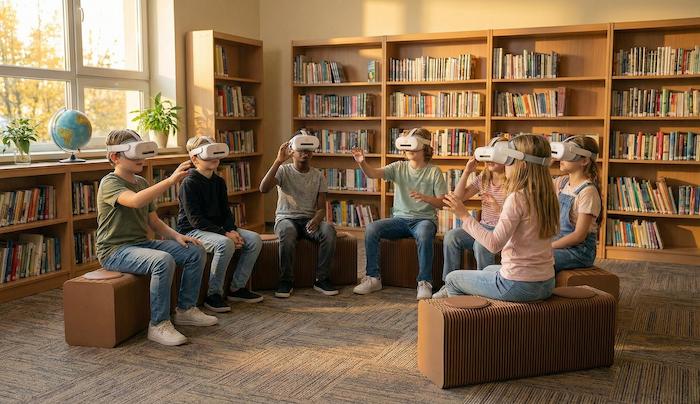
Virtual reality is a bit of a muddy term that makes people picture someone alone in their living room, controller in hand, cut off from everyone around them. That's not what happens here in a VR immersive cinema. Visitors do wear headsets, but they're synchronized across the whole room, so everyone experiences the same story at the same moment, seated together, the way an audience watches a movie rather than the way one person plays a game alone. The difference the headset actually buys you is a full 360-degree view, above, behind, below, that a fixed dome projection or a flat screen can't give you, since you can look anywhere in the scene and it's still there. This is based on the science of presence and maximizing learning outcomes.
See our approach to immersion based on actual science
What surprises most people is that there's actually a portable version of this too. ALICE Go from Hammer & Anvil is a portable, seated group VR theater that travels to libraries, school districts, museums, and community spaces, the same way a portable planetarium does, but built at a different scale. Capacity flexes from 10 to 150-plus seats depending on the room, it runs on one-button operation with a single staff member, and it's typically booked from $2,500 a month, with most institutions running it for one to three months and some school districts licensing it for a full school year. Because you never have to purchase any hardware, there’s no risk of obsolete headsets, broken equipment or lack of content.
Then there's the full-scale ALICE theater, the bigger sibling: a modular temporary installation for museums built as a standalone gallery exhibit, running for weeks or months with documentary-grade storytelling. Projectors, speakers and comfortable seating take this experience to the next level. It's designed for museums treating this as a headline exhibit and earned-revenue driver.
See the full-scale ALICE theater
Portable Planetarium or ALICE Go or Full ALICE Theater?
| Portable Planetarium | ALICE Go | Full ALICE Theater | |
|---|---|---|---|
| Footprint | 200–300 sq ft dome | Compact, travels to you | ~1,000 sq ft theater |
| Capacity | 20–30, on the floor | 10–150+, by room | 10–150+, theater seats |
| Typical run | Single session | Single event, 1–3 months rental, school year | Weeks to months |
| Content | Astronomy, night sky | Access to Hammer & Anvil's content library | Access to Hammer & Anvil's content library |
| Viewing method | Naked eye, fixed dome | Synced headset, full 360° | Synced headset, full 360° |
| Staffing | Trained dome operator | One button, one staffer | One button, existing staff |
| Investment | $3K–$10K+ purchase, or day rental | From $2,500/month | Revenue share or licensing |
| Best for | School outreach, single unit | Seasonal, libraries, districts | Marquee exhibit, earned revenue |
The Real Question Isn't Which Is Better. It's Which Job You're Hiring For
If what you need is a $500-a-day add-on for a single astronomy unit that a classroom teacher can book and forget, a portable planetarium does that job well, and there's no reason to overbuild it into something bigger than it needs to be.
If you're a library, a school district, or a museum looking for a season of programming, something that travels to you, runs itself, and covers more ground than a star show without the commitment of a permanent exhibit, that's the job ALICE Go was built for.
And if the problem you're actually trying to solve is "how do we get sustained foot traffic through the doors for a few months without a capital campaign, a new gallery build, or six months of staff training," that's a different job again. That's the one the full ALICE theater is built for, and it's why comparing all three on price alone misses the point. They're not competing for the same budget line.
Why We Built ALICE Around Removing Three Burdens
At Hammer & Anvil, we kept running into museums and libraries stuck between "too small to matter" and "too big, too permanent, too expensive to justify without years of fundraising." Both ALICE Go and the full ALICE theater were built to remove the three burdens that usually make that decision so hard.
There's no capital burden. No purchase, no fundraising campaign, no equipment sitting in storage after the season ends. There's no footprint burden either, whether that means a compact room for ALICE Go or roughly 1,000 square feet for the full theater, and either one leaves your space exactly as it found it when the run ends. And there's no operational burden, which is the one people don't expect: your staff presses one button, and it runs itself. No specialized operator, no weeks of training, just your team saying hello to visitors on their way in.
It feels a lot closer to a shared planetarium experience than a VR arcade, seated, synchronized, and built for people who've never tried anything like it before. It's just built with documentary storytelling instead of a star show, and sized to match whatever your institution is actually trying to do this season.
Browse the current film library
Frequently Asked Questions
What's the actual difference between a planetarium and a VR theater?
A planetarium projects stars and astronomy content onto a dome ceiling, usually for a single session. A VR theater is a seated, shared immersive cinema experience that can cover any documentary subject, available in a portable format (ALICE Go) or as a full-scale gallery installation.
Do visitors wear headsets in a VR theater?
Yes. Every visitor wears a lightweight headset, but they're synchronized across the whole room, so the group experiences the same story at the same moment, seated together, the way a movie theater works rather than the way solo VR gaming works. The headset is what gives each person a full 360-degree view, above, behind, below, that a fixed dome or flat screen can't provide.
How much does it cost to rent a portable planetarium?
Pricing varies by provider and region, but most portable dome rentals run on a day rate, while purchasing a dome outright typically falls somewhere between $3,000 and $10,000 depending on size and projector quality.
What's the difference between ALICE Go and the full ALICE theater?
ALICE Go is the portable version, seating 10 to 150-plus depending on the room, booked from $2,500 a month and built to travel to libraries, schools, and museums. The full ALICE theater is a larger, standalone installation built for museums running it as a multi-week or multi-month temporary headline exhibit.
Can a museum use both a portable planetarium and a VR theater?
Yes, and many do. They serve different programs: the dome supports outreach and classroom astronomy visits, while ALICE Go or the full ALICE theater functions as broader programming or a headline exhibit that drives general visitation and earned revenue.
Which One Fits Your Program?
If you're planning a school outreach season, a portable planetarium is a proven, well-supported tool, and there are excellent providers who specialize in exactly that. If you're a library, school district, or museum looking for a season of programming that travels to you and runs itself, that's ALICE Go. And if you're trying to solve a bigger problem, filling a gallery for a season, giving members a reason to come back, building an earned-revenue driver without a capital campaign, that's the full ALICE theater, and it's a conversation worth having with us.