
Frequently Asked Questions
Clear, honest answers to the questions museums ask most about immersive exhibits, ALICE, visitor comfort, staffing, budgeting, and daily operations.

Want to Talk Through Your Museum’s Needs?
If you're exploring immersive exhibits or want clarity on space, staffing, or visitor flow, we're here to help.
VR and Visitor Comfort
-
Format matters more than the technology. The immersive exhibits that succeed tend to share three things: they seat a group rather than serving one person at a time, they include the whole audience rather than excluding part of it, and their content refreshes so the exhibit stays worth returning to. ALICE was built around all three. It is seated, accessible, synchronized, staff-friendly, and built for education rather than gaming, so it feels more like a shared planetarium or theater experience than a VR arcade.
-
Motion sickness in VR is usually caused by unstable camera movement and by simulated motion the body does not feel. All our films use grounded, stable camera motion designed for museum audiences, and there is no motion platform. Almost every visitor, including first-timers, finishes comfortably and fully engaged.
-
Yes. ALICE was designed for people with no VR experience. Visitors stay seated the entire time, and the visuals and pacing are intentionally accessible.
-
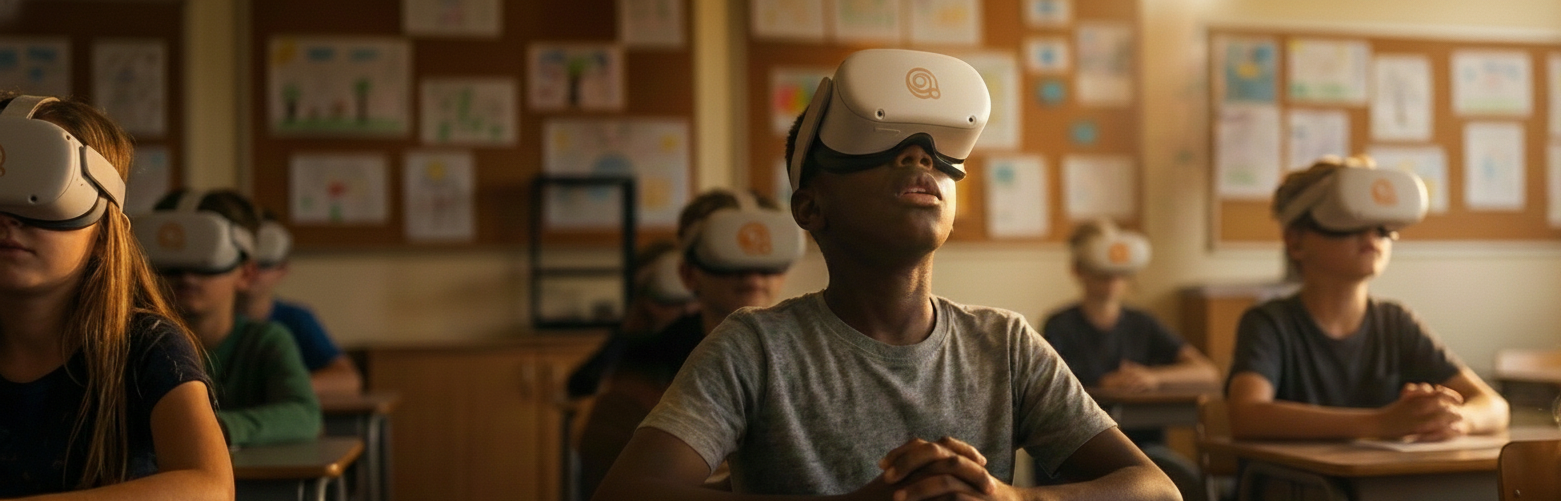
In most VR formats, no, which is why immersive exhibits often feel isolating. ALICE synchronizes every headset in the room, so the whole audience watches the same thing at the same moment, like a theater screening. It encourages conversation afterwards, especially with school groups.
-
Motion-based attractions and simulators are built around physical sensation, and they do that very well. An immersive theater is built around shared attention. There is no motion platform and no standing, capacity runs considerably higher, and the whole audience experiences the show together. If your goal is a thrill, a motion ride is a good answer. If your goal is educational programming a VR theater might be the right solution.
-
Reliability is the fear most museums raise first, usually after a previous tech exhibit failed. ALICE is built on simple, robust hardware tested for daily, museum-grade use. We monitor installations and support you throughout the entire run.
-
Owned technology does. Because ALICE is modular and rented rather than purchased, we upgrade components as needed over time. Museums do not have to invest in new equipment or redesigns. We handle the evolution of the technology. And we are constantly creating new titles so the experience always new.
-
Sustainability comes from content, not technology. Our film library grows annually, allowing museums to bring ALICE back year after year with new programming rather than the same experience.
Technology, Reliability, and Obsolescence
Questions About the Films and Educational Content
-
Both, when it is designed properly. Every film is built around clear learning outcomes and created with subject-matter experts in paleontology, physics, microbiology, geology, astronomy, and history. The research on immersive learning is consistent that shared, well-designed experiences improve retention, while poorly designed ones do not.
-
Our films focus on high-demand museum topics:
dinosaurs
space
the deep ocean
volcanoes
physics and quantum science
microbiology
-
We recommend age 7 and up, as children much younger may not sit through the entire experience.
-
Most run 15 to 20 minutes. We’ve found this is the best duration to account for attention span, visitor flow and to maximize daily throughput.
-
Less than most people expect and much less than a typical exhibit. Many of our customers use rooms as small as 1000 sq. ft. that don't get a lot of use normally.
ALICE is modular and adapts to small rooms, temporary galleries, multi-purpose rooms, and open-plan exhibits. No renovations or permanent installations are required.
-
Daily operation requires one button. Most museums run ALICE with the same staff who manage other exhibits, and no technical expertise is needed. Hammer & Anvil handles installation, calibration, support, and troubleshooting.
-
We provide remote support and ship replacement equipment quickly. Most issues are solved within minutes, and all equipment remains our responsibility.
-
Capacity is the main thing that separates immersive formats. Pods, motion seats, and single headsets serve a handful of people per cycle.
ALICE seats 10 to 150+ visitors at once depending on configuration, and most museums run the experience twice per hour.
-
ALICE is fully accessible. Visitors remain seated, and the layout adapts to mobility devices.
Many other VR experiences may not be. Attractions built on motion platforms or standing experiences carry restrictions on mobility, motion sensitivity, and height.
Space, Staffing, and Operations
-
There is no capital cost with ALICE. You are not buying hardware, you are hosting an exhibit, and we own and maintain all the equipment.
Two structures are available: a fixed monthly rental where you keep 100 percent of ticket revenue, or a revenue-share partnership with a mobilization fee and a share of the gate. Museums choose based on whether they have an exhibit rental budget.
-
Absolutely! We want our immersive theatres to create real revenue for museums.
Earned revenue comes down to throughput and access: how many visitors you can move through per hour, and how many of them can take part. Museums often see strong returns when ALICE is ticketed or used for timed-entry programming. It also supports grant funding in STEM, education, accessibility, and community engagement.
-
Past VR attempts often lacked:
educational content
accessibility
repeatable programming
group formats
operational support
ALICE solves these structural issues.
-
By renting rather than building. A temporary immersive theater arrives installed, runs for weeks or months, and leaves, with no construction, no purchase, and no board approval for a permanent build. That removes the capital campaign from the equation entirely.
Budget, Revenue, and Long-Term Value
Planning, Logistics, and Museum Fit
-
Typically 2-3 days, including training.
-
No. ALICE fits into existing spaces without renovations.
-
Yes. Museums often position the ALICE as:
a companion to dinosaur halls
a rotating immersive exhibit
an add-on experience for space or ocean galleries
a standalone temporary exhibition
-
Yes. We can schedule a demo of all our films.
-
Absolutely. We can schedule a demo of all our films.
-
A short conversation about your space, audience, and goals is all that’s needed. We’ll recommend a configuration and share next steps.